


Dalam dunia kesusteraan, khususnya khazanah perpuisian, seringkali disebutkan mengenai penyair-penyair yang sudah “mapan” menemukan cara berbicara mereka setelah perjuangan dan pelatihan bertahun-tahun. Semisal, ketika kita membaca juvenilia—puisi paling mula dari Sylvia Plath, kita akan mendiskreditkannya karena, seperti kebayakan kritikus sastra utarakan: “Dia belum menemukan cara berbicaranya sendiri.” Kita juga akan menemukan pendapat yang sama ketika membaca karya-karya awal dari penyair seperti Theodore Roetgke dan James Wright yang mana, seperti Plath, menulis puisi formal sebelum beralih ke puisi bebas selama masa kepenyairan mereka. Pada kenyataannya, lebih sulit “bersuara” alami dalam berpuisi jika kita memakai sajak dan matra, yang dibuat dengan sembarangan, dapat bersuara artificial atau ornamental. Namun, hal tersebut tidaklah terjadi pada kasus Plath, Roethke dan Wright. Ketika mereka matang sebagai penyair, mereka mulai menulis tentang orang-orang dan topik yang sepenuhnya yang ada disekitar mereka, untuk menyampaikan kebenaran-kebenaran yang kompleks.
Dalam bukunya—The Art and Craft of Poetry, Michael Bugeja lewat pertemuannya dengan penyair Amerika—Bruce Weigl, yang mana mempengaruhi proses kepenyairannya di kemudian hari, menyarankan kepada penyair muda untuk; Menggunakan suara yang sesuai.
Semisal saja, saya duduk di dalam kelas sebuah sekolah. Seorang guru, lalu, mulai menyampaikan materi pelajaran. Pada saat sang guru mulai memasuki kelas, kita, disadari ataupun tidak, sudah mengenakan topeng seorang murid. Dan jika guru tersebut ternyata adalah ibu saya sendiri, ketika pulang ke rumah saya pun akan berganti topeng seorang anak, begitupun sang guru. Inilah, topeng atau peran yang kita mainkan setiap harinya, mempengaruhi suara yang akan kita gunakan kepada orang-orang disekitar kita di tempat/situasi tertentu.
Seseorang, misalkan saja, setiap harinya akan mengenakan beberpa topeng:
· 6:30 Kau mesti membangunkan suamimu untuk kerja—sayangnya ia orang yang temperamen. Kau akan menyentuhnya dengan lembut di pundak dan disaat itu juga kau sudah mengenakan topeng seorang istri. Kau lalu akan berbisik lembut padanya: “ayo bangun, sekarang, sayang. Waktunya untuk bangun.” Kau memerankan peran seorang istri yang bertanggung jawab dank au pun menggunakan “suara” yang sesuai dif ajar di tempat tidur.
Lebih lanjut, Michael Burgeja menyarankan pada penyair muda untuk melatih ketajaman “telinga” nya terhadap puisi-puisi kontemporer maupun klasik. Berikut akan saya kutipkan salah satu contoh yang diberikan Michael Bugeja dalam hal yang sudah saya utarakan sebelumnya;
TH E QUEEN O F HEARTS
By Christina Rossetti
How comes it, Flora, that, whenever we
Play cards together, you invariably,
However the pack parts,
Still hold the Queen of Hearts?
(Voice: suspicious, sly, questioning)
BEAT! BEAT! DRUMS !
By Walt Whitman
Beat! beat! drums! blow! bugles! blow!
Through the windows — through doors — burst like a ruthless force,
Into the solemn church, and scatter the congregation,
Into the school where the scholar is studying; . . .
(Voice: loud, oracular, commanding)
TH E VOICE
By Thomas Hardy
Woman much missed, how you call to me , call to me,
Saying that now you are not as you were
Whe n you had changed from the one who was all to me,
But as at first, when our day was fair.
(Voice: plaintive, repetitive, sad)
Namun, penilaian ini tentu saja bukan penilaian mutlak yang mesti menjadi patokan. Perbedaan interpretasi tiap pembaca tentu saja memungkinkan penilaian yang lain. Dan itu sah-sah saja. Michael Bugeja melanjutkan bahwa, yang kita butuhkan adalah mendengarkan suara yang berbeda dari setiap puisi yang kita baca. Kemudian renungkan cara bersuara penyair tersebut dan lihat apakah telah terjalin harmonisasi dengan subjek dalam puisi tersebut.
Untuk mencoba apa yang telah dijelaskan Michael Bugeja, saya akan mencoba mengaplikasikan teknik penemuan suara dalam puisi Prabu—Perahu Napas.
Perahu Napas
lelaki duduk memangku laut tiada
selain menyeberangi nasib di kejauhan
bersama angin. . .
Suara (tenang, pengharapan, perenungan)
…angin utara yang berhasil turun
membawa perasan jantung perempuan bukit
menuju arah pantai
Suara (kehilangan, penemuan kembali)
sendiri ia berbisik
merangkum masalalu
melipat bangku kosong dan cerita hantu
sementara waktu perlahan karam
merapikan angan-angan
Suara (perenungan,kesunyian,kesendirian)
bersamanya perahu napas berlayar
melampaui tubuh dan pikiran …
Suara (titik balik,penemuan kembali)
…batas diam antara lubuk dan jantung laut
yang pecah membawa ia pulang
ke tugur masa depan
Suara (penemuan kembali)
2014
*Disampaikan dalam Ngobrol Pintar (NgoPi) komunitas LACIKATA pada tanggal 26 September 2015
….
Death does not come when a
body is too exhausted to live
Death comes, because the brilliance inside of us can only be contained for so long.
We do not die. We pass on, pass on the life burning through our throats
Death comes, because the brilliance inside of us can only be contained for so long.
We do not die. We pass on, pass on the life burning through our throats
.... .
Michael
Lee̶ ─Pass On
Four years ago, in the month of May, I never thought that he will pass
away in the age of eighty. He looks still healthy in his age, however. Walking
to the farm every morning, he brought his heavy hoe with him. He used to hoe
the farm and plant some vegetables plan there. He had often said to me: It’s always peaceful to be here, I can hear the music of the wind sounds like
Tayub**, and I had pity on him, for these days it was something rare to see
that the play of that Javanese culture. He usually sat under the tree which is
in the edge of the river when the sun got higher. From there, he could keep an eye on his farm.
It was a summer season where a flock of sparrow birds attack the farm
intensively. He will never let any bird to touch her plant. It was always I who
sent him his lunch. I usually brought a fishing rod with me. He had taught me a
great deal about fishing.
In the 22th of May, at noon,
as usual, I walked to his farm to bring his lunch. I saw him sat under the
tree. But there was something uncanny about him that time. When I called his
name, he didn’t answer. I thought he was sleeping. As I approached his body, I
saw his face was very grey and massive. There he lay, sleeping like he wouldn’t
wake up anymore, I thought. For some moment, I let him sleep. Then, when I
thought that he had slept long enough, I tried to wake him up. Softly I
whispered in his ear. But he didn’t give an answer nor did he make any
movement.
It was the third times I
whispered in his ear. But, still, there was no answer or a single movement. I
started to shake his body, again, and again. But, still, there was no sign of
life. If he was dead, I thought, I wouldn’t feel nothing when I touch the artery of his neck, for I knew that when someone had dead, the beat of his heart
would stop. Then I touched his front neck, trying to feel his heart beat. No, I
wouldn’t say he was exactly . . . but there was something queer . . . at that
time. I can’t feel any beat at all. Panicky, I left her body and I run as fast
as I can to my house.
I returned with some men and
women with me. One of them is a doctor who lived next to my house. We let the
doctor to check at him.
The doctor looked at me for a
while. I felt that his eyes were examining me. After looking at me, the doctor
said to me “Well, the breath already went out of him. He had a beautiful death,
God be praised”.
After I heard what the doctor
had said, I felt my soul was rejecting the fact. He was not dead! He just
looked as if he was asleep, he just looked that peaceful. But I can’t do
something to change the reality. They brought his corpse to the mourning house.
In the evening my father took me with him to
visit the house of mourning. It was after sunset; but the sky looked darker
than usual. My father and I entered the house, then. We walked quietly towards
the open door of the dead-room. A silence took possession of the little room
before all the mourners prayed for him.
That was unforgettable moment
in my life, to see things like that.
*To the memory of my grandfather
** Tayub or tayuban is
typical Javanese traditional arts, especially in Central Java and East Java.
Tayub is a term used by the Javanese in the art of dance accompaniment with one
unit of Javanese gamelan music of percussion, kenong, kempol, suwukan gongs,
trumpets, drums and angklung. In addition, the dancers Tayub usually also
hummed songs or poems that contain Java as couplets wise counsels, are like the
advice to foster home as well.. This art is very popular among the Java
community because it looks attractive, dynamic, aesthetic and expressive.
--Pablo Neruda
Kau topi ungu dan hati yang sama.
Di kedua matamu nyala api aram-temaram menyala.
Dan kenangan-kenangan jatuh di dalam air jiwamu.
Mendekap kedua tanganku seperti sebuah tanaman yang merambat.
kenangan-kenangan mengumpulkan suaramu, yang begitu lambat dan dalam kedamaian.
Api unggun kekaguman yang mana membakar dahagaku.
Bunga bakung biru manis membelit seluruh jiwaku.
Aku merasa kedua matamu melintas, dan musim gugur menjauh.
topi ungu, suara seekor burung, hati seperti sebuah rumah.
untuk kerinduan-kerinduanku yang dalam berpindah.
dan ciuman-ciumanku rubuh, bahagia seperti bara-bara api.
Langit dari sebuah kapal. Tanah lapang dari perbukitan.
Ingatanmu terbuat dari cahaya, asap, sebuah kolam yang sama.
Melewati kedua matamu, lebih jauh, malam-malam menyala.
Sisa-sisa musim gugur basah berkisar dalam jiwamu.
(Diterjemahkan secara bebas oleh Puguh Dwi S)
 |
Kalau
kemanusiaan tersinggung, semua orang yang berperasaan dan berpikir akan ikut
tersinggung, kecuali mereka yang gila atau berwatak kriminal.
—Pramoedya Ananta Toer
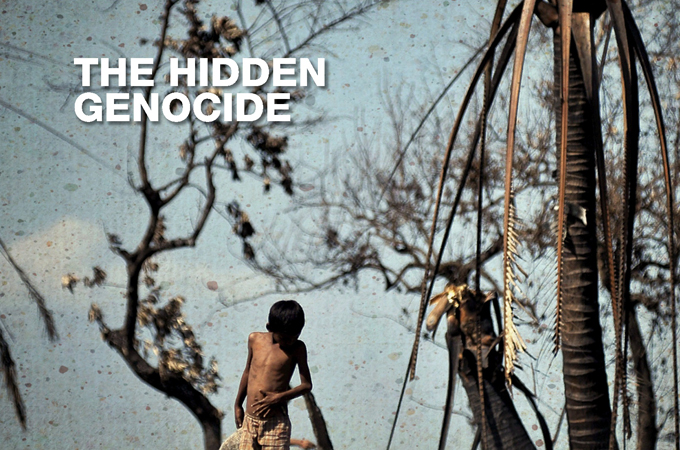
Rohingya Muslim is a minority people
among a Buddhist majority in Myanmar. They basically are the people of Myanmar,
but Myanmar considers the Rohingya to be immigrants from Bangladesh and West
Bengal. Therefore, the government of Myanmar has treated its Rohingya Muslim
people as intruders for years. The violence conflict between Buddhist and
Muslim communities rises to worsen in Myanmar since 2012. From that year on, many Rohingya Muslims have
been made homeless and hundred have been killed. The Myanmar government, who
have to take the charge for their people, especially Rohingya Muslims in this
case, has fled from their duty. Even thought they seem to respond the critic
from other countries by proposed an action plan that allowed Rohingya people to
gain their full citizenship, still it’s seem to be unrealistic opportunity for
Rohingya people. It’s unrealistic because the Rohingya are not eligible for
full citizenship unless they can meet the nearly impossible requirements—they
have to track their family history in Myanmar back to the days before British
colonization. Those who fail to meet the standards would be put into what
Myanmar calls “a resettlement zone”. Those who refuse to go through the process
would be assigned to a displacement camp. Facing the quite impossible
requirement, Rohingya Muslims decide to flee from that country by boat. They
drifted in crowded boats in the seas off Southeast Asia, begging for food and
water, some dying along the way. They throw the died-body to the sea. Some
others die when they jump to the sea to ask help from fisherman. Then, where is
the world when all this tragedy happened? Yes, the world has closed its eyes to
the agony of Myanmar’s Rohingya for too long. Indonesia and Malaysia are, at
least temporarily, taking in some of the migrants who suffering at the sea and
give them temporary residence. Thailand, which has agreed to help but won’t
take in more survivors, feed them food from helicopter like they are fish. Is
there any humanism left in our world? This is a very serious humanism tragedy
of our age. There are many reasons to save Myanmar’s Rohingya, but the main
reason, the basic reason, is that we have to reconsider the basic fundamental of
human right. Below I will give three justifications why Myanmar’s Rohingya crisis
is a serious humanism tragedy.
First of all, according to the
Universal Declaration of Human Rights which is made by the United Nations, all
human beings are born free and equal in dignity and rights (Article 1). It’s
clearly that everyone whether they Muslim, Christian, Buddhist, Hindus,
Catholic, or even an atheist deserve to get freedom and dignity in their life.
It’s not the one right to take someone or a community rights. What happened
with Myanmar’s Rohingya is a serious violation of the Human Rights. In
Myanmar’s Rohingya cases the role of United Nations itself is questioned. The
United Nations, who is represented the voice of Nations in the world, keep in
silent. They realize that there is a genocide crime which is did by Myanmar’s
government. They realize that the Myanmar’s government has failed on its role
as a government. As we know the violence conflict between Myanmar’s Buddhist
and Rohingya has revealed in 2012. But long day before it’s revealed the
conflict has emerged. It’s a suck of human rights tragedy for our age. The age
where technology and science has evolved rapidly, but it doesn’t followed by
humanism of the human itself.
The second is the idea of equality.
The idea of equality is another principle that we, as the human beings, have to
hold. The idea of equality itself can be devided into three types. They are political
equality, economical quality, and social equality. The first one that we have
to give to Myanmar’s rohingya is the social equality. The social equality is
very important in Myanmar’s Rohingya cases. It’s important because the social
equality will cover the status of Myanmar’s Rohingya. It will also confess them
as the member of human beings. Through this social equality Myanmar’s Rohingya will
not be differentiate with the other human beings. But unfortunately, the social
equality can only be achieved when political equality is at hand. Therefore,
when the role of Myanmar’s government has failed, the United Nations should
take an action in order to guarantee the idea of equality which is to be the
essential point of human rights.
The last is the right to life. Based
on the United Nations’ Universal Declaration of Human Rights article number 3,
“Everyone has the right to life, liberty and security of person,” it has stated
clearly enough that Myanmar’s Rohingya deserve to get their life, deserve to
get their liberty, and deserve to get their security. They deserve to life the way they want, and
it’s not the right of someone or even a country to take their freedom. If one who
dare enough to take the essential of human life that is the right to life, it
will absolutely a serious criminal. The other important note is, when we, the
member of human beings, knew such Myanmar’s Rohingya tragedy and we let this
genocide happen in our world it’s obviously we have totally lost our essential humanism.
As can be seen, when we let Myanmar’s
Rohingya crisis continuously happen, it’s quite clear that we will lost something important inside of us. It’s also clear enough that Myanmar’s Rohingya crisis is a serious
humanism tragedy. As some reasons which has mentioned above, they are:
1. Everyone deserve to get their dignity and freedom in their
life.
2. Everyone have the same opportunity to be equal in politic,
social, and economical.
3. Everyone have the
right to life.Picture taken from : http://www.aljazeera.com/mritems/Images/2012/ /5/201212519154861734_20.jpg
Dengan apa kita akan memulai cinta ini?
Dengan
rintik hujan
atau
pasir pesisir
Rintik
hujan itu kau tahu ia yang merawat rumput susut rindumu, bunga cinta yang rekah
di ranum matamu, atau tanah tegar yang senantiasa menghuni pelataran keresahanmu.
Rintik hujan itu, diberikannya rintik kerinduan pada semua yang bernama
kekeringan. Ia yang menjadi simfoni denyut-denyut percintaan lewat dedaunan,
tanah, atau sungai hingga semua bermuara di hatimu.
Atau
Pasir pesisir
yang senantiasa menyusuri pantai hatimu. Ia yang menuggu deru ombak kerinduan
yang tak kunjung datang. Ia bangunkan istana-istana yang lengang menunggu angin
laut membawa sebuah kepulangan. Kau mungkin akan mulai membenci setiap malam
datang sebab darinya angin malam akan mengantarkan sebuah keberangkatan.
Dengan apa
sebaiknya kita memulai?
Desember,
2014
/I/
Langit malam adalah alam mimpi yang lain,begitu keyakinanmu dari dulu.
Ketika kau
tak temukan bintang jatuh dalam mimpimu, kau senantiasa terjaga
dan seketika
tergagap mendapati langit malam masih juga menunggui tidurmu.
Ia yang senantiasa merawat keheningan untuk
semua yang membutuhkan
Ia yang akan menyiapkan hari baru bagi semua
kehidupan
Ia yang menidurkan
/II/
Kunang-kunang itu masih juga keluar dari
mimpiku, begitu
pikirmu kemudian.
Mereka
dengan kerlap-kerlipnya berlalu lalang menghindari tabung mimpi
yang kau
siapkan.
Barangkali hanya pada malamlah mereka bersetia
Barangkali karna malam ada maka mereka tercipta
Barangkali karna gelap dalam mimpiku yang fana
/III/
Ia yang malam begitu fana dimimpiku. Kadang kau kira ia sebatas ilusi
delusif dari
Setiap
kedipan matamu. Yang meski sudah kau pejamkan cukup lama, ia tak juga
Mencapaimu.
Pada pejam
terakhir, ia akan mendatangimu tanpa kau bisa sadari
Pada pejam
terakhir, ia akan merawat mimpimu yang mengabadi
Pada pejam
terakhir, takkan ada lagi yang kau sesali
Jawabku di
kemudian mimpi
Desember, 2014


